
Spiti Valley Tour Packages
Are you searching for the top attractions and best places to visit in Spiti Valley?
You are at the right place! KoiKoi Travel has created the perfect tour packages for you, covering all the must-see attractions of Spiti Valley.
We provide nice cars, great hotels, and very friendly guides to make your trip super fun and perfectly designed for you.
Scroll down to see the best Spiti Valley travel packages designed just for you! 👇
No tours found in Spiti Valley yet
Insider Travel Guide & TipsEverything About Spiti Valley
Essential travel guide, top attractions, weather, local tips & culture for Spiti Valley.
Read Full Guide Hide Guide
Everything About Spiti Valley
Essential travel guide, top attractions, weather, local tips & culture for Spiti Valley.
Top Attractions
Weather & Best Time
Spiti Valley: A Landscape Where Someone Took All the Colour Out
Spiti doesn't try to be pretty in the conventional Himachal sense — no dense pine forests, no waterfalls at every turn. What it offers instead is starker and more demanding: a genuine cold desert at nearly 3,800m, brown and grey mountains against impossibly blue sky, ancient monasteries clinging to cliffs, and villages that hold records like "highest post office" or "highest motorable village" almost as a matter of course. Spiti doesn't hand you its best moments easily — you have to drive rough roads, sit with the altitude, and slow down enough to actually see what's around you. When you do, it delivers something no other part of Himachal quite matches.
Top Attractions in Spiti Valley
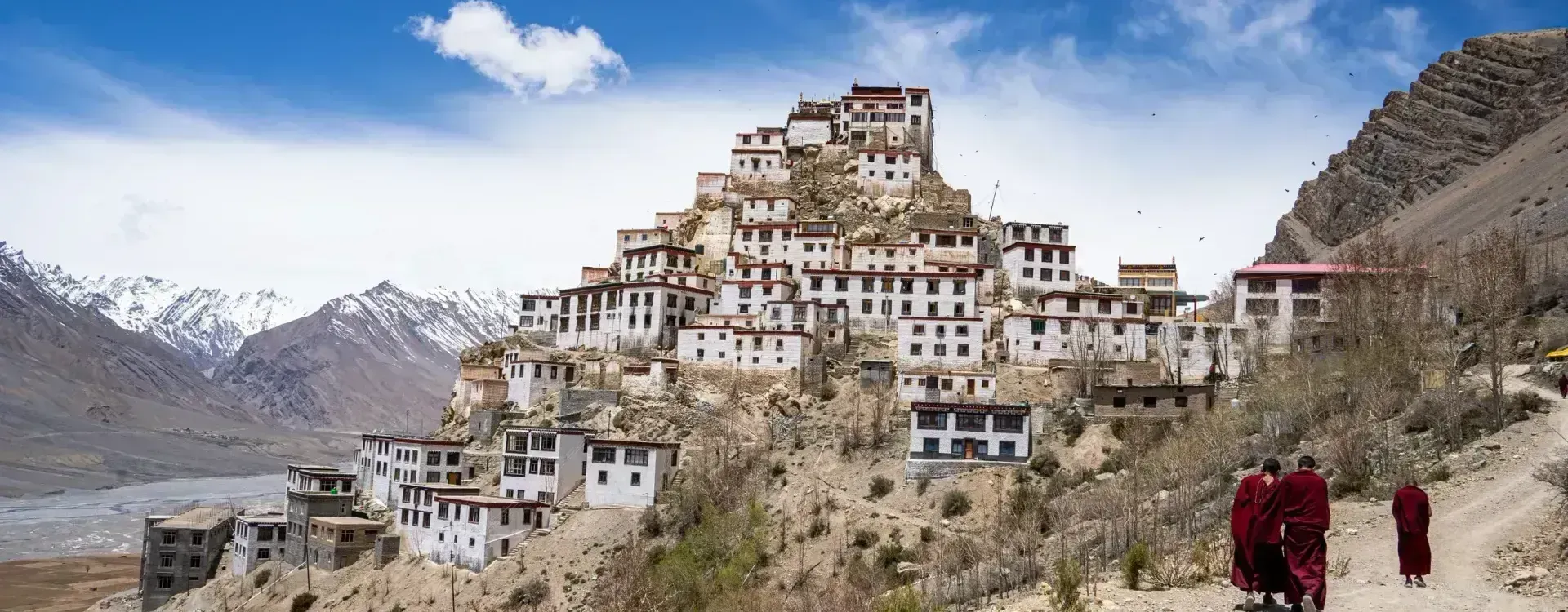
Key Monastery (Kee Gompa) — Spiti's largest and most visited monastery, roughly 1,000 years old, perched at 4,166m about 12 km from Kaza
Tabo Monastery — founded in 996 AD, sometimes called the "Ajanta of the Himalayas" for its ancient murals, and under consideration for UNESCO status
Dhankar Monastery and Lake — a dramatic monastery perched on a pinnacle above the confluence of the Spiti and Pin rivers, with a rewarding 2 km trek up to a still, reflective high-altitude lake
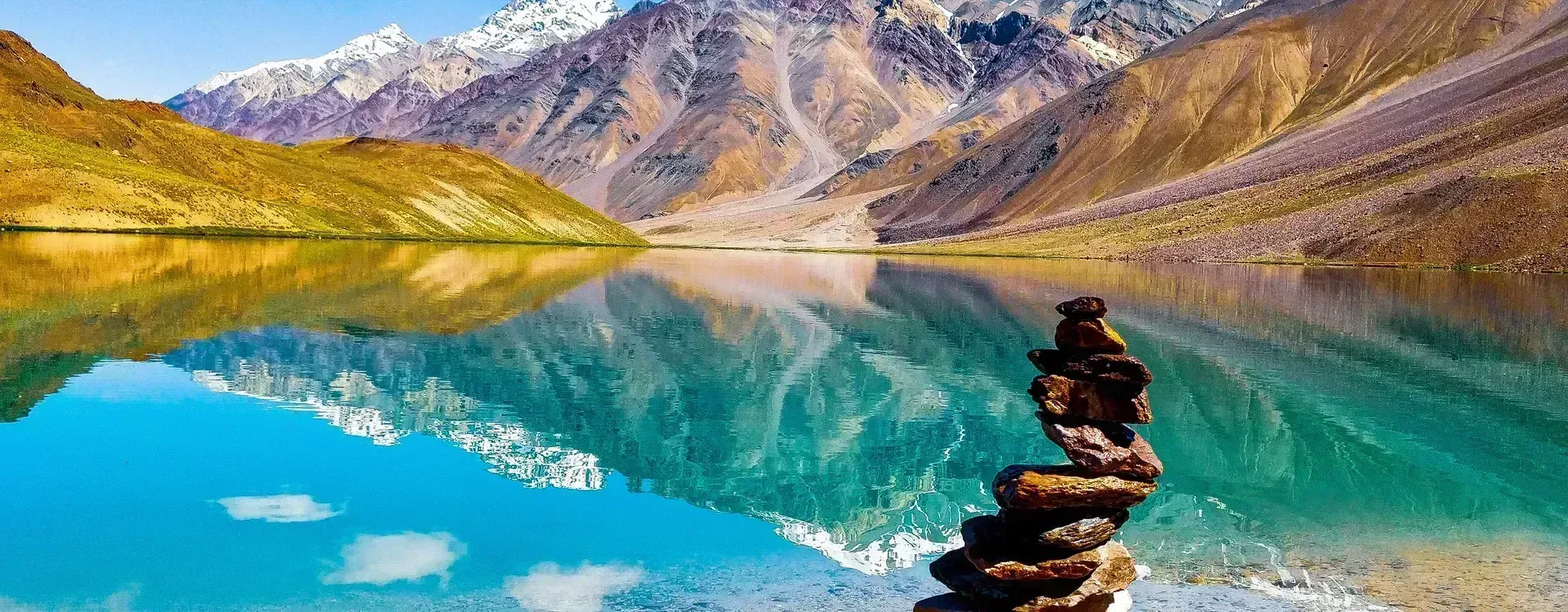
Chandratal Lake — a crescent-shaped "Moon Lake" at 4,300m, one of the most beautiful high-altitude lakes in India, accessible only June to September
Langza, Komic and Hikkim — a trio of villages forming Spiti's most famous circuit: Langza for marine fossils sitting in the dirt at 14,500 feet, Komic as the highest motorable village in the region, and Hikkim home to the world's highest post office
Pin Valley National Park — a side valley and snow leopard habitat, one of the best places in India to spot the elusive cat with patience and a local guide
Kaza — The Practical Base
Kaza is Spiti's administrative headquarters and the natural base for exploring the valley, sitting at roughly 3,650-3,800m along the Spiti River. It's a small town of around 4,000 people, with a main market street, a growing cluster of cafes and guesthouses, a fuel station (fill up here — it's genuinely important given how sparse fuel stops are elsewhere in the valley), and a Community Health Centre that handles basic medical emergencies including altitude sickness. Most travellers spend at least 2-3 days based here, using it as a launch point for the surrounding monastery and village circuits.
Permits — What You Need to Know
Indian nationals don't need any special permit for the main Spiti circuit — Kaza, Tabo, Key Monastery, Dhankar, Langza, Komic, Hikkim and Chandratal are all open with just a valid photo ID. An Inner Line Permit (ILP) is only required if travelling beyond Sumdo toward Shipki La on the India-China border, an area most standard Spiti itineraries don't include.
Foreign nationals similarly don't need a permit for the main circuit, though a Protected Area Permit (PAP) is required for areas near the Indo-Tibet border, such as Gue or beyond Sumdo, obtainable at the DC office in Reckong Peo or Kaza.
Separately, there's a local development charge under SADA (Spiti Area Development Authority), collected at entry barriers when entering the valley — this is different from an Inner Line Permit and applies to all visitors as a small local fee.
Note: Permit rules and border-area restrictions can shift, so it's worth verifying current requirements at the DC office in Shimla or Kaza, or via the Himachal Pradesh e-permit portal, before travel.
Chandratal — Timing Matters
Chandratal Lake is one of Spiti's most photographed destinations, but it's also the most time-restricted — accessible only June to September, with the Kunzum La pass (4,590m) on the Manali-Kaza route officially open only from late May through mid-October, giving travellers roughly 150 days a year for the complete loop including Chandratal. Early October visits are sometimes possible but genuinely unreliable after the 10th, and the lake becomes completely inaccessible once winter sets in. Given this narrow window, it's worth confirming current road and pass status before building Chandratal firmly into your itinerary, especially if travelling near either end of the season.
Two Routes Into Spiti
Via Manali (Kunzum Pass): The more dramatic, higher-altitude route, open only late May to mid-October, taking roughly 10-14 hours in a single push (though splitting across two days is genuinely advisable). This route puts you at Chandratal's doorstep on the way in.
Via Shimla-Kinnaur: A more gradual, reliable route open year-round, passing through Narkanda, Rampur, Jeori and Reckong Peo before entering Spiti through Tabo and Kaza. This route takes 12-14 hours, best split across two days with a break in Reckong Peo or Tabo, and is the more sensible option for early or late-season travel when Kunzum La might still be closed.
Many travellers combine both, entering via one route and exiting via the other for a complete loop rather than backtracking.
Best Food to Try in Spiti Valley
Spiti's food reflects its Tibetan Buddhist character and cold desert setting — Thukpa, momos and butter tea are staples throughout Kaza and the surrounding villages. Given the harsh growing conditions, local produce is limited, and much of what's served relies on supplies brought in from outside the valley, so don't expect much variety beyond straightforward, warming meals suited to the altitude and cold.
Best Shopping in Spiti Valley
Kaza's market street has small shops selling Buddhist souvenirs — prayer flags, singing bowls, thangka prints — along with basic warm clothing and trekking supplies. This isn't a major shopping destination; most visitors come for the landscape and monasteries rather than markets.
Dress Code in Spiti Valley
Given Spiti's cold desert climate and altitude (most destinations sit between 3,500 and 4,600 metres), serious warm layering is essential regardless of season — nights get genuinely cold even in peak summer. At monasteries like Key and Tabo, modest clothing covering shoulders and legs is expected, and shoes should be removed before entering prayer halls.
Culture of Spiti Valley
Spiti's culture is deeply Tibetan Buddhist, visible in its ancient monasteries, its Losar celebrations, and the quiet rhythm of village life shaped by short growing seasons and long, isolating winters. Tabo Monastery in particular carries genuine historical weight, founded over a thousand years ago and often compared to Ajanta for the significance of its preserved murals. The valley's extreme geography — barren, high-altitude, cut off from much of the outside world for half the year — has shaped a resilient, close-knit local culture that remains less commercially developed than more accessible parts of Himachal, even as tourism has grown steadily in recent years.
Major Festivals in Spiti Valley
Losar (Dec/Jan): The Tibetan/Spitian New Year, celebrated with prayers, feasts and traditional performances at monasteries across the valley.
Key Monastery Chaam Festival: A masked ritual dance festival held at Key Monastery, drawing pilgrims and visitors for its ceremonial Cham performances.
Ladarcha Fair: A traditional trade fair historically tied to Spiti's old trading routes, now also a cultural and community gathering.
Language Spoken in Spiti Valley
Hindi is understood in Kaza and tourist-facing areas, though less universally than in more mainstream Himachal destinations.
Spitian, a dialect closely related to Tibetan, is the everyday language among locals.
English has limited but growing presence among guesthouse owners and guides given increasing tourism.
Traveller tip: Build in proper acclimatisation days, especially on arrival in Kaza — with most of the valley sitting between 3,500 and 4,600 metres, Acute Mountain Sickness is a genuine risk here, not just a theoretical warning, and rushing the itinerary is the single most common mistake first-time visitors make.
Suggested 7-Day Itinerary (from Manali)
Day 1: Manali to Kaza via Kunzum Pass, acclimatise on arrival. Day 2: Explore Kaza market, visit Key Monastery at sunset. Day 3: Village circuit — Langza (fossils and Buddha statue), Komic (highest motorable village), Hikkim (world's highest post office). Day 4: Kaza to Dhankar (monastery and lake trek), continue to Tabo for overnight. Day 5: Tabo Monastery exploration, onward to Nako Village on the Kinnaur route. Day 6: Chandratal Lake (if road confirmed open), optional Batal camping. Day 7: Return to Manali via Rohtang Pass, or continue to Shimla via Kinnaur.
Best Time to Visit Spiti Valley
Mid-June to mid-October is the sweet spot for the complete circuit including Chandratal, with June, September and early October offering the cleanest weather. June brings early-season crowds and rougher, unrepaired roads; September and early October offer settled roads, crisp air and excellent photography conditions with noticeably fewer crowds. May (late) sees the Manali side just opening, with lingering snow patches near Kunzum and light crowds for those willing to brave slightly rougher conditions. Winter (November-April) makes most of the valley inaccessible due to heavy snow, though the Shimla-Kinnaur route to Kaza, Tabo and Dhankar remains passable year-round for genuinely adventurous winter travellers.
How to Reach Spiti Valley
The nearest airport is Bhuntar (Kullu-Manali), connected to Delhi, with the onward journey to Spiti completed via the seasonal Manali-Kaza road (open May-October) or the year-round Shimla-Kinnaur route. There's no railway station in Spiti itself — Shimla or Chandigarh serve as the nearest practical rail links for those approaching via Kinnaur. A minimum of 7-10 days is recommended for a proper Spiti trip, including travel time, given how much of the experience depends on slow, deliberate movement through a landscape that genuinely doesn't reward rushing.
With KoiKoi Travel , discover the monasteries, cold desert landscapes and ancient Buddhist culture of Spiti Valley on a journey to one of the Himalayas' last true frontiers.
Frequently Asked Questions about Spiti Valley
Helpful answers to common traveler questions when planning a trip to Spiti Valley.
Still have questions about your trip?
Talk to our destination specialist for personalized itinerary guidance & custom quotes.